San Lorenzo, Puerto Rico
The Town of the Samaritans
 San Lorenzo (san lo-REN-zo) is known as the “Land of Legends,” the town of the “Samaritans,” and the “Samaritan City,” titles that reflect an identity deeply rooted in oral tradition, faith, and community service. The municipality honors Our Lady of Mercy (Nuestra Señora de las Mercedes) and Saint Lawrence (San Lorenzo) as its patron saints, from whom the town takes its name and primary devotion.
Located in the eastern region of Puerto Rico, San Lorenzo borders Gurabo to the north, Juncos and Las Piedras to the east, Caguas to the west, and Patillas and Yabucoa to the south. This location connects the municipality both to the island’s interior valley and to the mountainous foothills of southeastern Puerto Rico.
From a geographic standpoint, San Lorenzo lies primarily within the Caguas Interior Valley, an area characterized by fertile lands well suited for agriculture. However, its southeastern sector rises into the Sierra de Cayey, forming part of the Eastern Humid Mountains, with more rugged terrain, forested areas, and natural springs that enrich the municipality’s landscape.
San Lorenzo’s economy originated in the hato system, based on cattle ranching. Over time, sugarcane cultivation was introduced, processed in haciendas equipped with steam-powered and ox-driven mills, along with the production of coffee and minor crops. Although timber production was once significant, it declined due to excessive deforestation.
Today, the municipality’s economy is driven primarily by manufacturing, including the production of clothing, leather footwear, and electronic equipment. These industries are complemented by small-scale agriculture and livestock farming, which continue to play an important role. This combination of industry, agriculture, and tradition defines the modern economic and social character of San Lorenzo.
Foundation and History of San Lorenzo
San Lorenzo is known as the “Land of Legends,” the town of the “Samaritans,” and the “Samaritan City,” titles that reflect an identity deeply rooted in oral tradition, faith, and community service. The municipality honors Our Lady of Mercy (Nuestra Señora de las Mercedes) and Saint Lawrence (San Lorenzo) as its patron saints, from whom the town takes its name and primary devotion.
Located in the eastern region of Puerto Rico, San Lorenzo borders Gurabo to the north, Juncos and Las Piedras to the east, Caguas to the west, and Patillas and Yabucoa to the south. This location connects the municipality both to the island’s interior valley and to the mountainous foothills of southeastern Puerto Rico.
From a geographic standpoint, San Lorenzo lies primarily within the Caguas Interior Valley, an area characterized by fertile lands well suited for agriculture. However, its southeastern sector rises into the Sierra de Cayey, forming part of the Eastern Humid Mountains, with more rugged terrain, forested areas, and natural springs that enrich the municipality’s landscape.
San Lorenzo’s economy originated in the hato system, based on cattle ranching. Over time, sugarcane cultivation was introduced, processed in haciendas equipped with steam-powered and ox-driven mills, along with the production of coffee and minor crops. Although timber production was once significant, it declined due to excessive deforestation.
Today, the municipality’s economy is driven primarily by manufacturing, including the production of clothing, leather footwear, and electronic equipment. These industries are complemented by small-scale agriculture and livestock farming, which continue to play an important role. This combination of industry, agriculture, and tradition defines the modern economic and social character of San Lorenzo.
Location and Geography of San Lorenzo
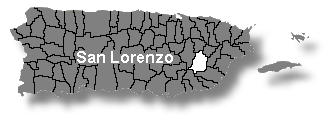 San Lorenzo is located in the central-eastern region of Puerto Rico, occupying a strategic position that connects the Caguas Interior Valley with the mountainous foothills of the island’s southeastern region.
The municipality borders:
This location has historically allowed San Lorenzo to function as a link between the urban area of greater Caguas and the agricultural and mountainous regions of southeastern Puerto Rico, encouraging residential, commercial, and industrial development within the municipality.
Geographic Setting
From a physical perspective, San Lorenzo belongs primarily to the Caguas Interior Valley, a region characterized by relatively flat and fertile terrain. However, its southeastern sector extends into the Eastern Humid Mountains, where some of the most significant elevations of the Sierra de Cayey are found, creating a more irregular topography and a natural environment of high ecological value.
This combination of valley and mountainous terrain has directly influenced:
- The availability of water resources
- Historical agricultural development
- Modern urban expansion
- The municipality’s diverse landscapes
Area and Demographic Data
Land Area
San Lorenzo covers approximately:
- 137.8 square kilometers
- 53.0 square miles
This places it among the largest municipalities by land area in the central-eastern region of Puerto Rico.
Population
- 40,488 residents — 2020 United States Census
This figure reflects relative demographic stability compared to previous decades, with growth concentrated in residential areas near the urban center and along major transportation corridors.
Population Density
- 294 residents per square kilometer
- 761 residents per square mile
The highest population concentration is found in the urban center (Pueblo) and in neighborhoods with continuous residential development, while the mountainous areas retain a more rural character.
Demonym
- Sanlorenceños
Nicknames
- The Town of the Samaritans
- The Land of Legends
These titles summarize San Lorenzo’s historical, spiritual, and cultural identity, deeply connected to its traditions of solidarity, popular legends, and natural richness.
Neighborhoods of San Lorenzo, Puerto Rico
The municipality of San Lorenzo is territorially organized into an urban center (Pueblo) and a series of rural and suburban barrios that reflect its geographic, social, and economic diversity. This administrative division is the one officially used by the U.S. Census Bureau for statistical and planning purposes.
Territorial Organization
- San Lorenzo Pueblo concentrates the main administrative, commercial, and service functions, including City Hall, public plazas, and historic buildings.
- The rural and suburban barrios maintain a mix of residential, agricultural, and industrial uses, with mountainous areas toward the south and flatter terrain toward the valley.
This territorial structure has supported balanced development, allowing urban growth while preserving traditional communities and reinforcing San Lorenzo’s identity as The Town of the Samaritans and The Land of Legends.
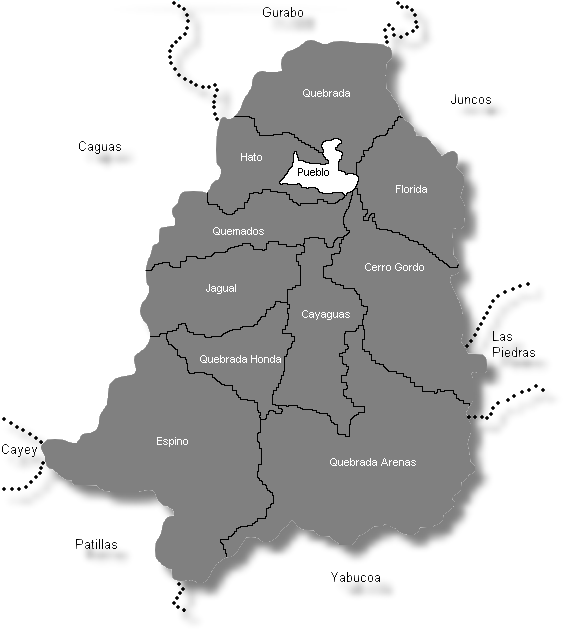
| Census 2020: Population by Wards - San Lorenzo |
Habitants |
| Cayaguas | 1,321 |
| Cerro Gordo | 4,033 |
| Espino | 3,170 |
| Florida | 5,323 |
| Hato | 6,311 |
| Jagual | 3,959 |
| Quebrada | 2,231 |
| Quebrada Arenas | 2,473 |
| Quebrada Honda | 2,087 |
| Quemados | 4,392 |
| San Lorenzo Pueblo | 2,035 |
| Total | 40,997 |
Source: Censo 2020
Relevant Demographic Notes
- The highest population concentration continues to be located in Hato, Florida, Quemados, and Cerro Gordo, reflecting residential development patterns and roadway accessibility.
- The urban core (San Lorenzo Pueblo) maintains its administrative and commercial role, although with lower population density compared to surrounding suburban neighborhoods.
- The population decline since the 2000 Census follows the broader trend observed in inland and eastern municipalities of Puerto Rico, associated with migration, an aging population, and economic changes.
Economy of San Lorenzo
San Lorenzo’s economy has undergone a significant transformation over time, evolving from a predominantly agricultural and livestock-based foundation into a more diversified model that integrates manufacturing, commerce, and services, while still maintaining strong rural roots.
Economic Evolution
During the 18th and 19th centuries, San Lorenzo developed mainly around cattle ranching (hato), subsistence agriculture, and later the cultivation of sugarcane, coffee, and minor crops. Timber production was also important in early stages, although it declined over time due to intensive forest exploitation.
Industry and Manufacturing
Today, San Lorenzo is recognized as a municipality with a strong manufacturing presence in the central-eastern region of Puerto Rico. Key industrial activities include:
- Apparel and textile manufacturing
- Leather footwear production
- Electronic and electromechanical equipment manufacturing
- Light industry serving both local and export markets
This sector has played a central role in job creation and in integrating San Lorenzo into regional production chains.
Agriculture and Livestock
Although smaller in scale than in the past, minor crop agriculture and livestock farming remain relevant economic activities, particularly in rural barrios. These activities support local consumption and nearby markets.
Commerce and Services
Local commerce, professional services, and public-sector employment complement the municipal economy. San Lorenzo’s proximity to Caguas, Juncos, and Gurabo has facilitated workforce mobility and regional economic integration.
Religious Patronage and Spiritual Life
San Lorenzo’s patron saint is Our Lady of Mercy (Nuestra Señora de las Mercedes), a Marian devotion deeply rooted in the spiritual and cultural life of the community. Devotion to Our Lady of Mercy has been a central element of San Lorenzo’s religious identity for generations.
Parish of Our Lady of Mercy
Mailing Address:
P.O. Box 1280
San Lorenzo, Puerto Rico 00754
Phone: (787) 736-2571
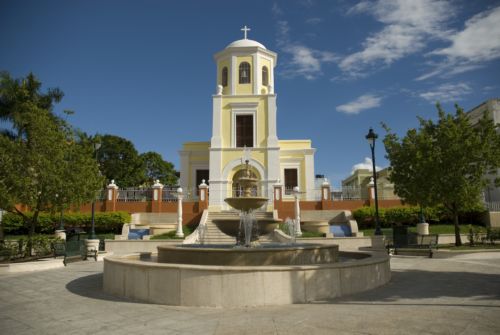
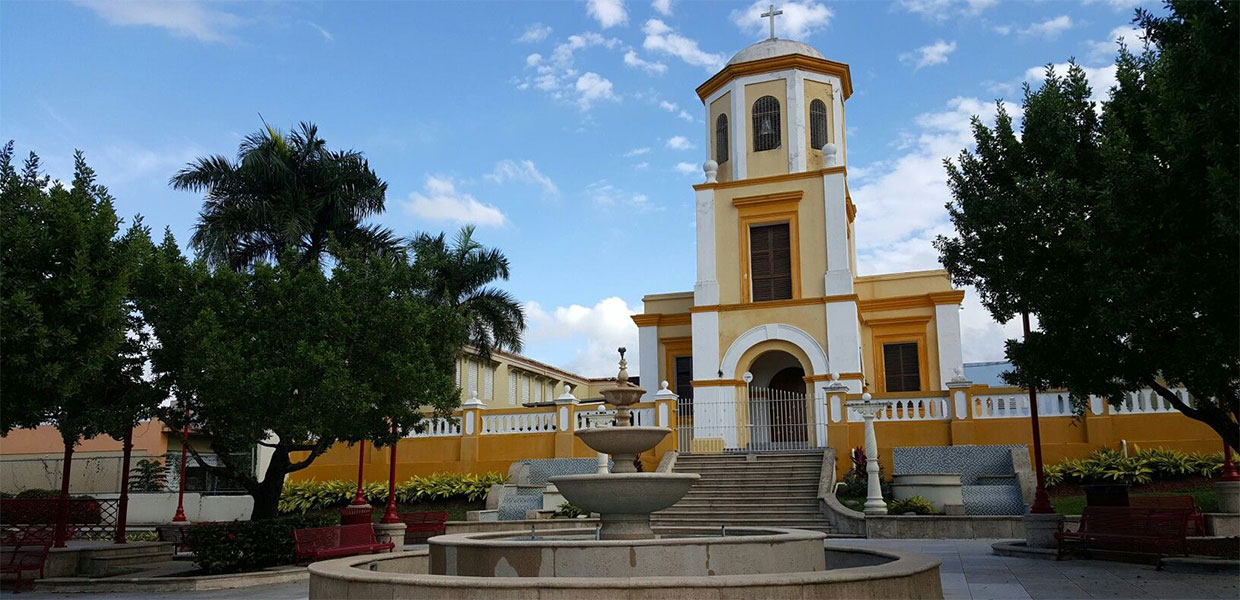
The parish serves as the municipality’s primary religious center and hosts the most important liturgical celebrations of the year, including the patron saint festivities held traditionally in September. Beyond its religious role, the church has historically functioned as a community gathering place and an architectural landmark of the town center.
Topography and Relief
San Lorenzo features varied topography that reflects its position between two major geographic regions of Puerto Rico:
- Caguas Interior Valley, characterized by relatively flat and fertile lands suitable for agriculture and settlement
- Sierra de Cayey, particularly in the southeastern sector, where more pronounced elevations and a mountainous landscape associated with the Eastern Humid Mountains are found
This combination of plains and mountainous terrain has directly influenced barrio distribution, land use, and the municipality’s economic development.
Hydrography
San Lorenzo is part of important eastern Puerto Rico watersheds and is traversed by several rivers and tributaries, including:
- Río Grande de Loíza – one of the longest and most significant rivers on the island
- Río Emajagua
- Río Cayaguás
- Río Las Vegas
These waterways have been essential for agriculture, historical water supply, ecological balance, and the natural landscape that characterizes San Lorenzo as an inland eastern municipality rich in water resources.
Municipal Symbols of San Lorenzo
San Lorenzo’s municipal symbols—the flag and coat of arms—officially represent the town’s history, faith, geography, and cultural identity. Both are closely tied to the municipality’s origins and religious tradition.
Flag of San Lorenzo
 The flag of San Lorenzo was officially adopted on September 5, 1972. Its design is inspired by the coat of arms of the Muñoz de Oneca lineage, the family of the town’s founder, Valeriano Muñoz de Oneca.
Design Description:
- Divided into four equal rectangles
- Upper left and lower right quadrants are yellow
- Upper right and lower left quadrants feature alternating horizontal red and yellow stripes
Symbolism:
- Yellow (gold): nobility, faith, and prosperity
- Red (gules): sacrifice, courage, and strength
Together, the colors reflect the municipality’s historical heritage and civic identity.
Coat of Arms of San Lorenzo
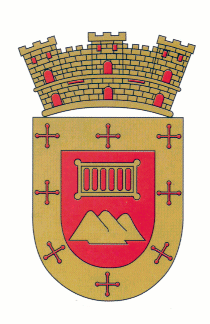 TThe municipal coat of arms integrates religious, historical, and geographic elements that define San Lorenzo.
Key Elements and Meaning:
- Gold and red colors: Derived from the Muñoz de Oneca family crest
- The grill: Traditional symbol of Saint Lawrence, deacon and martyr, who according to tradition was martyred on a grill
- The hill or mountain: Represents Cerro Gregorio, one of the municipality’s most prominent natural landmarks
- The pomelled cross: A heraldic attribute of Saint Michael the Archangel, the original patron when the settlement was known as San Miguel de Hato Grande
Overall Meaning
Together, the flag and coat of arms express historical continuity, religious devotion, community pride, and the deep connection between San Lorenzo and its natural and spiritual environment. These symbols serve as enduring emblems of identity and collective memory for the people of San Lorenzo.
Events and Traditions of San Lorenzo
San Lorenzo maintains a diverse cultural calendar that blends religious celebrations, community festivals, and traditional expressions, reflecting its identity as The Land of Legends and The Town of the Samaritans.
Three Kings Serenade (January)
A traditional musical procession celebrating Epiphany, keeping Christmas music alive while fostering community sharing across different neighborhoods of the municipality.
Moncho Roldán Horse Parade (January)
A deeply rooted equestrian event that honors jíbaro traditions and notable figures of San Lorenzo’s cultural heritage.
Kite Festival (March)
A family-oriented, recreational celebration highlighting kite flying as a cultural symbol, featuring outdoor activities, music, and broad community participation.
Feast of the Holy Cross (May)
An ancient religious tradition celebrated in communities and barrios through prayers, devotional songs, and cultural activities.
Patron Saint Festivities of Our Lady of Mercy (September)
The municipality’s most important religious celebration, combining liturgical services and processions with music, crafts, and cultural events.
Embroidery and Weaving Festival (September)
An event that showcases traditional artisan skills—especially embroidery and weaving—practices closely tied to San Lorenzo’s cultural identity.
Passion Fruit Festival (November)
A gastronomic and agricultural festival highlighting one of the region’s characteristic fruits, promoting local agriculture and the community economy.
Together, these activities strengthen social cohesion and pass down traditions that have endured for generations.
Places of Interest in San Lorenzo
San Lorenzo offers a mix of natural, cultural, and recreational attractions that reflect its geographic diversity and historical richness.
Natural Attractions
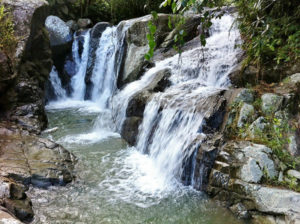
- Charco Los 7 Chorros – A popular natural area known for its waterfalls and natural pools, ideal for ecotourism and recreation.
- Cerro La Santa – An emblematic elevation with scenic and cultural value.
- Río Grande de Loíza (nearby sections) – An important natural resource linked to the regional ecosystem.
Cultural and Urban Heritage
- Parish of Our Lady of Mercy – The municipality’s principal religious and historic temple.
- Puente de la Marina – A historic structure associated with urban development.
- Priscila Flores Theater – A cultural venue dedicated to the performing arts and community events.
- Gallera San Carlos – A traditional site linked to a historical cultural practice in Puerto Rico.
Recreational Spaces
- Rancho Quintana – A recreational area used for family and community activities.
These sites form part of the town’s collective memory and contribute to San Lorenzo’s cultural and tourism appeal.
Notable Figures from San Lorenzo
San Lorenzo has been the birthplace of prominent individuals who have left a mark on music, politics, culture, and Puerto Rican history.
Distinguished Citizens:

- Chayanne (Elmer Figueroa Arce) – Internationally acclaimed singer and actor, one of the most recognized figures in Latin music.
- Priscila Flores – Known as La Alondra de San Lorenzo, a distinguished performer of traditional Puerto Rican music.
- Antonio Fernós Isern – Physician and politician; Puerto Rico’s first Resident Commissioner under the Commonwealth.
- Generoso Morales Muñoz – Historian and journalist; author of important research on local history.
- Carmita Jiménez – Puerto Rican singer with a notable national career.
- Ernestina Reyes Vásquez – Known as La Calandria, singer and composer of traditional rural music.
- José Tous Soto – Attorney and senator.
- María E. Machín – Distinguished figure in civic and professional institutions.
Cultural Legacy
Together, these personalities reflect San Lorenzo’s impact on music, politics, popular culture, and intellectual life, reaffirming its identity as a town of deep traditions and national significance.
Public Schools sorted by educational levels.
San Lorenzo District
| Name | Level | Telephone | Address |
| CARMELO FIGUEROA | Elementary | (787) 736-6424 | PO Box 994 |
| EL PARQUE | Elementary | (787) 736-8995 | PO Box 440 |
| ESPINO | Elementary | (787) 736-0086 | PO Box 1283 |
| EUGENIO MARIA DE HOSTOS | Elementary | (787) 736-0650 | PO Box 1285 |
| GERARDO SELLES SOLÁ | Elementary | (787) 736-2351 | PO Box 1285 |
| HATO PARCELAS | Elementary | (787) 736-5444 | PO Box 1238 |
| JAGUAL | Elementary | (787) 736-8898 | PO Box 994 |
| JOSÉ ROSARIO | Elementary | (787) 736-5830 | Lado Parque de Bomberos |
| JOSEFA DOMINGO | Elementary | (787) 736-5880 | PO Box 1281 |
| LUIS MUŃOZ RIVERA | Elementary | (787) 736-5856 | PO Box 1283 |
| LUIS MUŃOZ RIVERA (VIEJA) | Elementary | (787) 736-2051 | PO Box 1283 |
| MANUEL CRUZ | Elementary | (787) 736-9269 | PO Box 1283 |
| QUEMADOS | Elementary | (787) 736-1546 | PO Box 1251 |
| GENEROSO MORALES MUŃOZ | Intermediate | (787) 736-6658 | PO Box 1281 |
| MARÍA CRUZ BUITRAGO | Secondary | (787) 736-9272 | PO Box 1283 |
| DRA. MARÍA T. DELGADO DE MARCAN | Secondary | (787) 736-0470 | PO Box 9929 |
| QUEBRADA HONDA | Secondary | (787) 736-8989 | PO Box 1289 |
| CARLOS ZAYAS | Secondary | (787) 736-9633 | PO Box 1281 |
| JAGUAL ADENTRO | Secondary | (787) 736-7877 | PO Box 1283 |
| JOSÉ CAMPECHE | High School | (787) 736-2701 | Calle Emilio Buitargo |
Hymn:
By: Raúl A. Torres Irizarry and Elpidio Montalvo
Son tus campos de bellísimo verdor
y tu gente como ninguna
pueblo que guardas en tus suelos
una historia de inmenso valor.
Posees riquezas dignas de admirar
el Río Grande y el Cerro Gregorio.
Vistes de fe y esperanza nuestro ser
cuando hablamos de tu santa montańa.
Oh, Samaritana eres mujer ejemplar
nuestro gran tesoro fue heredar tu identidad.
Orgulloso yo viviré del pueblo que represento
con la frente en alto te diré es mi pueblo
San Lorenzo, San Lorenzo.